The missing number in signalling naira devaluation risk

Feature Highlight
If the conversation about naira stability is going to be data-driven, it needs numbers.
Ask anyone in Lagos what drives the naira, and you'll get three answers: Central Bank of Nigeria (CBN) policy, oil prices, and politics. All three are correct, but only in a vague sense, which renders them useless for actual decisions. The entire country has an opinion on the exchange rate, yet nobody publishes a standardised daily measure of the structural pressure on the naira. That is a striking gap for Africa's largest economy.
We built one. It's called VNG-FXR, the Venoble Nigeria FX Risk Composite Index. It combines CBN external reserves and Bonny Light crude oil prices into a single daily figure. Above 1,000 indicates low risk relative to the past year. Below 1,000 indicates elevated risk. The index has been consistent across every major devaluation event since 2006, which is either a useful signal or a coincidence. We think it's the former.
VNG-FXR COMPOSITE INDEX LEVEL SINCE INCEPTION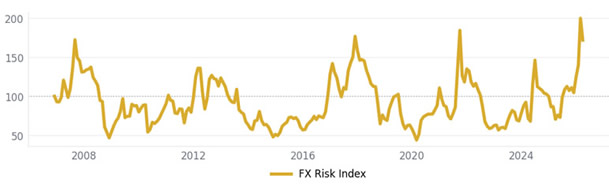
Rebased to 1,000 at inception (December 2006). Higher = lower FX risk.
Why reserves and crude, and nothing else
Reserves indicate what the CBN can deploy to defend the naira. Crude oil prices reflect the income stream that replenishes those reserves over time, flowing through the Nigerian National Petroleum Corporation (NNPC) and the Federation Account Allocation Committee (FAAC) before reaching the central bank's balance sheet.
One is ammunition. The other is the supply line.
When both fall simultaneously, you're watching a central bank deplete a buffer that isn't being replenished. That's the structural precondition for devaluation. Between 2014 and 2016, crude collapsed from $118 to below $26, and reserves fell from $43 billion to under $24 billion. The COVID-19 pandemic caused a similar situation in 2020, cratering both oil prices and the reserves. In each case, VNG-FXR fell below 1,000 months before the CBN moved the official rate.
Could you add parallel market data or offshore non-deliverable forward (NDF) spreads? You could, but neither is published by any official source and adding them would break data continuity going back twenty years. We chose inputs that are freely available and verifiable across the full history. The model trades completeness for reliability; that's a deliberate choice, though it means the index reacts more slowly to pure-sentiment shocks than a trader would like.
How it works in practice
Each day, the index calculates a z-score (a measure of how far a value is from its recent average) for both reserves and crude relative to their rolling 252-day average, roughly one year of trading days. This matters because "low" means different things in different eras.
Reserves of $24 billion in 2016 were at a crisis level. That same $24 billion in 2006 would have meant abundance. The two z-scores are weighted 60% reserves and 40% crude, then mapped to the index level. We put more weight on reserves because they're the immediate constraint; crude is a leading indicator, but revenue takes months to flow through NNPC, past FAAC allocations, and into the CBN's actual balance sheet.
What makes this useful for policy analysis? The index adapts to regime changes without manual recalibration. After the 2023 unification (where the CBN effectively let the naira float), the rolling window absorbed the new equilibrium within a year. There is no need to rebuild the model every time the monetary framework shifts; the normalisation handles it.
What this tells us about Nigeria
We are not going to oversell this. A reading below 1,000 doesn't mean devaluation is imminent. It means the macro preconditions are in place. The CBN can defend the naira well below that level for extended periods (and has done so multiple times) by imposing capital controls or rationing FX access.
But the pattern is hard to ignore.
12-MONTH ROLLING COMPOSITE RETURN
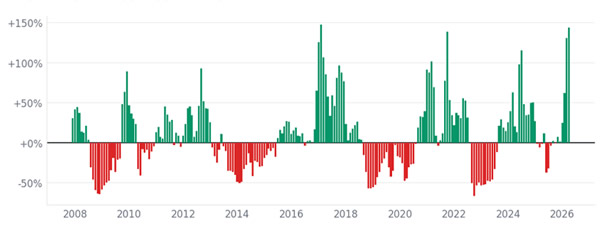
Every major devaluation in the last two decades was preceded by a sustained reading below 1,000. Below-1,000 readings have also resolved without devaluation, though, which is an important caveat. The signal has been necessary even when it hasn't been sufficient. For policymakers and allocators trying to have a serious conversation about naira stability, that's still worth knowing; it tells you when to pay closer attention, even if it can't tell you when to run.
The policy question is whether a transparent, daily risk signal improves decision-making or just amplifies anxiety. We think the answer is straightforward. Every other major currency has standardised risk metrics published daily. Nobody produces one for the naira, and that gap says more about the state of Nigerian macro data infrastructure than about whether the tool would be useful. If the conversation about naira stability is going to be data-driven, it needs numbers. This is ours.
Ejiye Jimeta Ibhawoh is CEO of Venoble Limited, a Canada-based capital markets solutions firm focused on frontier markets. Venoble maintains VCORE, a structured database covering every corporate event and security in West Africa since 1998.
Other Features
-
Nigeria’s Paris Club debt deal: A factual rejoinder to Donald Duke
Obasanjo’s credit was never in danger and did not require Duke to vandalise everyone else’s contribution.
-
Where to sell Steam gift cards in Nigeria: Rates, apps and how to ...
See where to sell Steam gift cards in Nigeria, current 2026 Steam card rates, and how to get paid on ...
-
Nigeria is building a sustainable health financing future
Gavi’s US$500 million support will help protect Nigeria’s children over the next five years while ...
-
An analysis of the Executive Order on Virtual Assets 2026
The new presidential executive order addresses a real problem – the cost and risk of regulators working in ...
-
Nigeria’s digital finance push needs a human override ledger
Nigeria should require that every consequential AI-enabled financial workflow maintain a human-override ledger.
-
Nigeria's maize waste could power a new renewable financing model ...
For a country still importing the bulk of its ideas on biomass financing from elsewhere, the data to build a ...
-
Tinubunomics and Nigeria’s natural economic healing
Nigeria’s economy does not wait for policy to recover from shocks. Recoveries are built into its cycles.
-
Tinubu’s big agenda for health tech
President Tinubu’s health reforms are laying the digital and scientific foundations for Nigerian health‑tech ...
-
FITC ESG conference urges policy shift from sustainability pledges ...
At the 2026 FITC Sustainability & ESG Conference in Lagos, regulators, business leaders and development ...


Most Popular News
- FCCPC probes possible cement price manipulation as prices hit N15,000
- Airtel rolls out Africa’s first Starlink mobile service in DRC
- US lifts 12-year port security restriction on vessels from Nigeria
- KudiWave raises compliance concerns over N750m transfer by PalmPay
- AFC raises CHF 350 million digital bond in Swiss market
- Oil futures rise as Middle East truce stalls
Quick Search for Upcoming Events
Event Categories