Law’s struggle for dignity
Feature Highlight
If Netanyahu gets his judicial reform passed, Israel’s courts will become increasingly partisan.
Introduction: In the massive protests sweeping Israel this year, the pioneer of the Supreme Court's authority to strike down legislation has become a focus of attention, underscoring what is at stake in Western democracies more broadly. If populist autocrats succeed in reducing democracy to majority rule, the first victim will be human dignity.
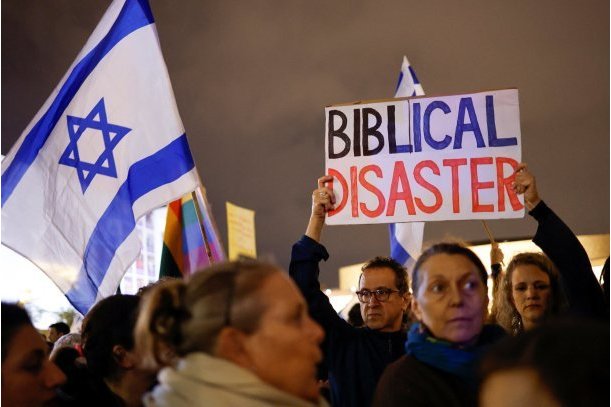
One telling development in the popular demonstrations against the Israeli government’s proposed judicial reforms has been the concentration of protesters on a small side street in Tel Aviv. Here one finds the home of the Israeli Supreme Court’s former president, Aharon Barak, now a target of both praise and obloquy, depending on one’s political allegiances.
Judges are not supposed to be a direct source of political controversy, whether they handed down their most recent decision yesterday or, as in Barak’s case, almost two decades ago. They are supposed to be dispassionate and independent. But democracies in the twenty-first century are dispensing with this ideal, owing not to the conduct of judges, but to emerging autocratic populism, with governments lashing out at any institution that seeks to hold them to account.
In Israel and other democracies, the judiciary has been one of the primary checks against abuses of government power. That is why Israeli Prime Minister Binyamin Netanyahu focused his government’s attention on courts when he returned to power in late 2022. In draft legislation that has since been put on hold, his new government – an alliance between his Likud party and the fascistic Jewish Power party – seeks to curtail the Supreme Court’s power of judicial review, and to exercise greater political control over judicial appointments.
Barak finds himself at the heart of this political conflict because he was the justice who transformed the Supreme Court into a bastion of justice and the rule of law. Appointed to the Court in 1978, having served as Israel’s Attorney General since 1975 and as the government’s legal adviser at the Camp David Accords, Barak set about redefining the court’s role and shaping Israel’s jurisprudence.
From the start of his judicial career, Barak embraced activism. He helped expand the Supreme Court’s jurisdiction, defining justiciability (by which courts decide what matters they are competent to rule on) and standing (who is qualified to bring cases) broadly, thereby authorizing the justices to consider cases from a wider range of parties and on a broader range of issues.
Barak’s judicial philosophy truly came into its own following the Knesset’s (parliament’s) enactment of Israel’s Basic Laws in the early 1990s. He did not become president of the Supreme Court until August 1995; by that November, he had already handed down his most seminal decision, transforming his belief that “the world is filled with law” into a judicial reality. In United Mizrahi Bank v. Migdal Cooperative Village, the Court declared that it had the power to invalidate statutes which conflicted with the Basic Laws.
This was Israel’s Marbury v. Madison moment. The majority opinion revolutionized the Supreme Court’s role in Israeli democracy by furnishing it with the power to scrutinize almost every facet of Israeli public life. No longer was the Court’s remit confined to ruling on the reasonableness of government action; now, it could also strike down legislation, as in the United States.
Until this point, the Knesset’s policymaking had been treated as inviolable, with Israel mirroring Britain’s embrace of absolute parliamentary sovereignty. But as Britain has discovered in the wake of the Brexit referendum, its own notion of sovereignty sometimes leaves fundamental rights and democratic norms at the mercy of malign government ministers.
Simply because they command sufficient support in the legislature, former Prime Minister Boris Johnson and current Prime Minister Rishi Sunak have been able to pass legislation limiting the right to protest, disenfranchising some voters, and persecuting asylum seekers. In response, the British courts have seen it as their constitutional responsibility mostly to watch from the sidelines.
Under the jurisprudence pioneered by Barak, Israel’s Supreme Court would be less willing to tolerate such constitutionally dubious policies. In true liberal-democratic fashion, it recognizes that elected branches’ prerogative to carry out a mandate from the people must be weighed against the judiciary’s responsibility to uphold the law and its constitutional underpinnings. As Barak wrote in United Mizrahi, “judicial review of the constitutionality of the law is the soul of the constitution itself. Strip the constitution of judicial review and you have removed its very life.”
Rather than accept a thin, formal conception of democracy as mere majority rule, Barak offered a vision of “substantive democracy, which is concerned with the defence of human rights in particular.” Through this philosophy, the Court struck down a statute permitting Israel’s interior minister to detain asylum seekers without trial; ruled against the constitutionality of a “settlement regularization” law that allowed the government to expropriate privately owned Palestinian land; and determined that private prisons violated prisoners’ dignity.
While Barak’s critics (and critics of liberal judicial activism, like Netanyahu) claim that the court is “legislating from the bench,” the court’s defence of human dignity rests on firm, politically impartial philosophical terrain: everyone in society is free and equal under the law. By striking a “proper balance” between the “social life of the community” and “human rights, equality, and justice,” Barak argues, the judiciary avoids entangling itself in the political thicket.
This sensibility can be contrasted with the more partisan approach that one finds at the US Supreme Court. There, professed judicial philosophies serve as mere fig leaves for achieving favoured political agendas. Rather than rooting their decisions in coherent principles like dignity, justices rely on capacious frameworks like originalism and textualism to impose their personal and religious views.
This approach often allows justices to avoid the charge of “activism.” When one of Netanyahu’s previous justice ministers, Ayelet Shaked, appointed six new justices to the Supreme Court, she proclaimed that the judiciary would return to a supposedly neutral textualism. As Alon Harel of the Hebrew University of Jerusalem notes, she failed to appreciate that “her passion to promote conservative causes distort[ed] her ability to discern right-wing activism.”
If Netanyahu gets his judicial reform passed, Israel’s courts will become increasingly partisan. Already, the Supreme Court has retreated from the jurisprudential high point of the Barak era, such as by reducing its support for Palestinian rights. Justices will become overtly political players, and the Court, like its US counterpart, will suffer declining trust and credibility. And, in the absence of judicial review, Israelis can expect a wave of legislation that mocks their dignity.
Nicholas Reed Langen, a 2021 re:constitution fellow, edits the LSE Public Policy Review and writes on the British constitution for The Justice Gap. Copyright: Project Syndicate.
Other Features
-
3 infrastructure gaps Nigerian lenders can’t afford to ignore
The lenders that lead over the next year will be those that treat credit not as an isolated transaction, but as a ...
-
Monica Cash gains ground as best crypto platform as Bitcoin to ...
Monica Cash gains ground as best crypto platform as Bitcoin to Naira transactions rise across Nigeria.
-
Where do jobs really come from: A short note
Jobs are not created for their own sake; they emerge when people perform tasks that create value others are willing ...
-
Driving Africa’s fair energy transition through technology and ...
Bart Nnaji canvases decentralised approaches as essential to Africa’s path towards universal energy access.
-
Africa is not poor. It is illiquid
Charles Awanda poignantly describes Africa as a continent trapped between abundance and paralysis, and where wealth ...
-
When infrastructure becomes a bottleneck: Why we need to invest in ...
To succeed, entrepreneurs must become ecosystem innovators, building not only their products or services, but also ...
-
How Much Is a $100 Apple Gift Card in Naira: Best Rates
Find out how much a $100 Apple gift card is worth in Naira and where Nigerians are getting the best rates today.
-
Bridging the CPI gap: What Nigerian investors actually earned ...
Whether the NBS eventually publishes its own chain-linked series or the market continues to rely on independent ...
-


Most Popular News
- IMF issues cautious praise for Nigeria’s reforms, warns of hardship
- Dangote receives $600 million backing for fertiliser expansion project
- Ripple invests in Flutterwave to accelerate African stablecoin payments
- ILO adopts landmark treaty on gig work
- S&P assigns Afreximbank investment grade rating
- Africa CDC welcomes $220 million boost for Ebola outbreak response
Quick Search for Upcoming Events
Event Categories