
Efem Nkam Ubi, Professor of International Relations/Strategic Studies and China-Africa Studies, Institute of African Studies, Zhejiang Normal University, Jinhua, China.
Follow Efem Nkam Ubi
 @PapaFemo
Subjects of Interest
- Economic Development
- Geopolitical Analysis
- International Affairs
- International Trade
China and the Gifting of the “Eye of West Africa” 10 Jun 2026
The date, 29 April 2026, has become historic for both the Chinese government and the Economic Community of West African States (ECOWAS). That day, the Chinese government officially inaugurated a state-of-the-art headquarters for ECOWAS, aptly named the "Eye of West Africa," in Abuja, Nigeria. This modern facility received full funding from China through a $56.5 million grant. The new headquarters consolidates the ECOWAS Commission, Parliament, and Court of Justice to enhance administrative efficiency and give impetus to regional integration.
China's aid to Africa has now delivered a new initiative. Chinese foreign aid is guided by the 1964 Eight Principles for Economic and Technical Assistance to Other Countries, which emphasise equality, mutual benefit, and the absence of conditionality. Over the past 70 years, China has provided substantial political, economic, and technical support to Africa. This has funded and constructed thousands of infrastructure and development projects across the continent. Most of this assistance has been provided through sovereign loans and gifts.
Currently, China is the largest bilateral creditor in Africa and a key provider of development finance. It leads all other foreign nations in infrastructure investment across the continent, proving to be the only country willing to support significant hard infrastructure projects in regions often overlooked by Western aid agencies and private investors. Although data on Chinese foreign aid is somewhat limited, research conducted by AidData and the Boston University Global Development Policy Centre reveals that between 2000 and the early 2020s, Chinese loans and grants to African nations exceeded $160 billion. In that period, China’s financial commitments to Africa totalled approximately $180.87 billion, with 49 African governments and seven regional institutions being the beneficiaries of the allocation. In summary, Africa has received the largest share of China's foreign aid, accounting for 44% to 50% of annual global aid flows.
The central question is: what motivates such significant donations to Africa, particularly the recent contribution to the regional organisation? The answer lies not far afield; it is crucial to understand the complexities of China’s foreign aid to developing nations from two key perspectives. First, Chinese generosity is deeply embedded in its cultural tradition of gift giving, which emphasises the "careful selection of gifts." This reflects a long-standing ethos of benevolence in Chinese culture. Second, Chinese grants, regardless of their nature, signify a substantial gesture within the context of China's strategic diplomacy and collaboration with African nations. These efforts aim to cultivate goodwill, promote long-term cooperation, and support shared development.
From a Chinese perspective, Grants are financial aid provided at no cost, primarily in the form of goods or services, designed to support recipients in developing small- to medium-scale social welfare projects. 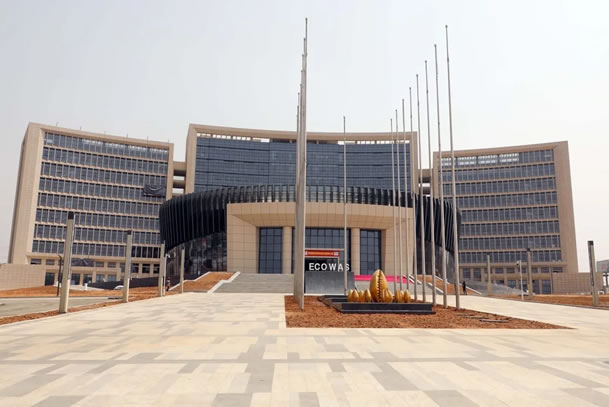
A front view of the Ecowas Secretariat, Abuja, donated by China
Studies suggest that hundreds of specific Chinese infrastructure projects do not involve loans; they are Chinese government non-repayable aid, which I described as "aid-in-kind", used to build projects at no cost for the recipient country. These may include initiatives such as stadiums, presidential palaces, cultural centres, schools, hospitals, low-cost housing, and water supply systems. Additionally, Chinese aid-in-kind can also be allocated for human resource development cooperation, technical support, emergency humanitarian aid, in-kind assistance, and the building of office complexes, such as the African Union and the ECOWAS secretariats, on the continent.
There is no gainsaying that this gesture serves as a cornerstone of Beijing's several core diplomatic and strategic goals for the developing world, especially Africa. A further question for us to ponder is: what significance does this Chinese benevolence have for the member countries of ECOWAS and the African region in general?
To begin, let us explore the crucial issue of the commitment that advanced countries have demonstrated to their pledges made to African nations. I have consistently highlighted the stark contrast between making promises and actually fulfilling them. Many commitments from advanced countries have often remained merely rhetorical. In contrast, China frequently follows through on its promises, with the "Eye of West Africa" initiative serving as a prime example of its genuine commitment. This remarkable project not only demonstrates China's dedication but also reflects its pragmatic approach to honouring its commitments to African nations.
By swiftly bringing substantial and high-profile infrastructure projects to fruition, China effectively counters the often hollow rhetoric emanating from the West. This proactive stance positions China as a reliable partner to many African nations, offering support "with no strings attached," and showcases a willingness to engage and invest in the continent with real, measurable outcomes, especially where others have refused to invest.
By creating a sophisticated and centralised administrative hub for the ECOWAS, China is taking a significant step toward enhancing the operational efficiency of this vital regional partner. This initiative not only optimises administrative processes but also demonstrates China's commitment to being a strong ally in advancing regional integration among West African nations. This investment, indeed, serves as a catalyst for fostering greater African unity.
It is also a strategic move that aligns with China's broader vision for reinforcing collaborative initiatives in Africa. It reflects a deep understanding of the importance of strengthening ties between member nations and facilitating joint efforts to address common challenges. Through this investment, China aims to promote shared progress by encouraging economic growth, infrastructure development, and social advancement throughout the region.
This initiative also stands as a compelling testament to the profound commitment to partnership and collaboration among nations. There is no gainsaying that the primary objective of this initiative is to cultivate a more interconnected and prosperous Africa, while simultaneously showcasing the essence of South-South solidarity, particularly between China and other developing countries. This is as embodied in the Bandung Conference of 18-24 April 1955, where priority was given to shared growth and mutual support, which not only expand development opportunities but also foster economic prosperity for the developing world and China, with Beijing placing particular emphasis on the member states of ECOWAS.
The gift also reflects China's soft power strategy in Africa, which is likely to foster significant political goodwill and long-term strategic influence for the country. This approach will enable China to secure valuable partnerships, enhance bilateral trade and investment, and gain diplomatic support on the global stage.
Additionally, the benevolence represents China's engagement with Africa's dynamic markets, which present substantial opportunities for economic growth. The expanding economies of ECOWAS member states offer a range of opportunities for trade and investment, allowing China to access the growing consumer markets and resources.
This bilateral relationship has the potential to create mutually beneficial outcomes, where both China and African nations can thrive through strategic cooperation and comprehensive development. Ultimately, this initiative aims not only to strengthen economic ties but also to promote common prosperity and a sustainable future for all stakeholders.
Efem N. Ubi is a Professor at the Institute of African Studies, Zhejiang Normal University, Jinhua, China, and former Director of Research and Studies at the Nigerian Institute of International Affairs, Lagos, Nigeria.
Latest Blogs By Efem Nkam Ubi
- Nigeria's new 4-Ds foreign policy faces an old test
- Was Nigeria absent or excluded from WAICO?
- At 105, China’s CPC offers Africa a lesson in ideology
- Nigeria at the precipice of a Hobbesian state
- China and the Gifting of the “Eye of West Africa”




Subscribe
Subscribe now to receive newsletter from Financial Nigeria.