Implications of SEC’s revised minimum capital requirements for capital market operators in Nigeria

Feature Highlight
Capital Market Operators should ensure that they implement robust controls to ensure that any funds introduced in the course of recapitalisation are properly sourced.
Introduction
The Securities and Exchange Commission (SEC) released a circular on 16 January 2026 on the revision of the minimum capital applicable to all categories of regulated capital market entities.
The circular was released to strengthen market resilience, enhance investor protection, align capital adequacy with the evolving risk profile of market activities, and ensure that regulated entities possess sufficient financial capacity to discharge their obligations in a sustainable manner. The circular was released pursuant to the SEC’s statutory authority under the Investments and Securities Act 2025 (ISA) to regulate and develop the Nigerian capital market. The circular takes immediate effect and directs all affected Capital Market Operators (CMOs) to ensure full compliance on or before 30 June 2027. Failure to comply with the prescribed capital requirements within the stipulated timeframe may result in regulatory sanctions or withdrawal of registration, as determined by the SEC.
The circular applies to entities regulated by the SEC, which include operators with core and non-core regulated functions such as brokers, dealers, registrars, trustees, underwriters, fund managers, amongst others; market infrastructure institutions; capital market consultants, financial technology (fintech) operators; Virtual Asset Service Providers (VASPs) and commodity market intermediaries such as commodity brokers. Notably, the circular introduces minimum capital requirements for certain VASPs that were previously not subject to any prescribed capital threshold.
In this article, we examine the objectives of the SEC’s revised minimum capital requirements, explore their potential impact on the capital market landscape, and outline the recapitalisation and strategic options available to affected market operators.
The revised minimum capital requirements for some regulated entities are highlighted below:
Core Regulated Functions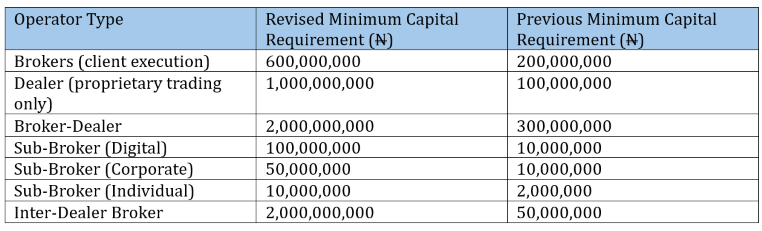
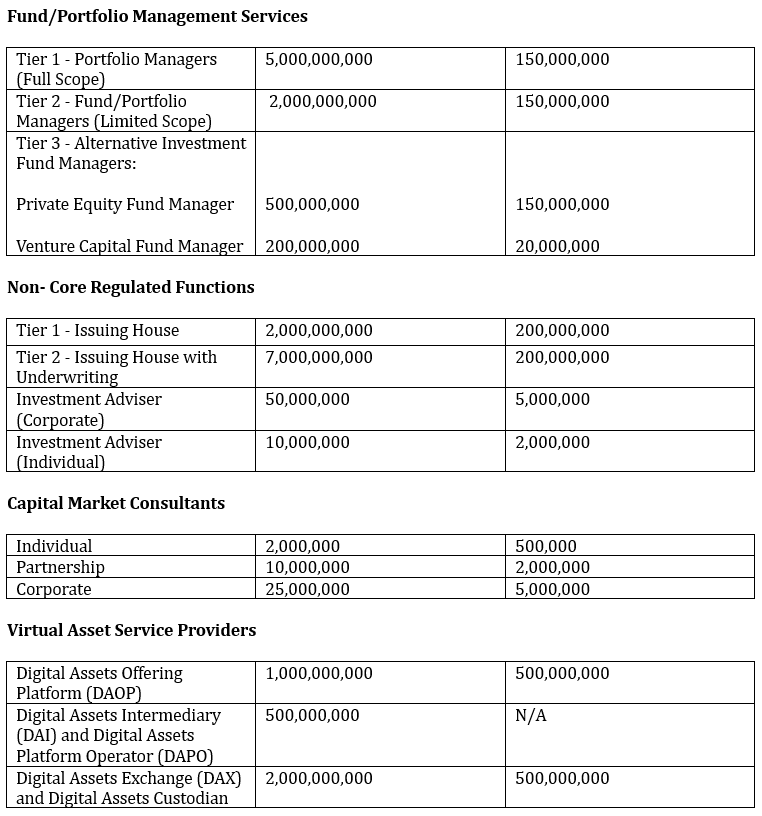
For the complete breakdown of the revised minimum capital thresholds for all the entities, reference should be made to the Circular.
Recapitalisation and Restructuring Options for CMOs
CMOs impacted by the revised minimum capital requirements will be required to adopt deliberate capital-raising and restructuring strategies. This may include proactive capital planning and strategic collaborations, alongside efforts to raise new capital or restructure existing business lines to align with regulatory thresholds. Some of the more practical compliance measures are discussed below.
Capital Raising from Shareholders and Investors
One of the most direct pathways for compliance with the SEC’s revised minimum capital requirements is capital injection from existing shareholders or new strategic investors. Affected capital market operators may strengthen their shareholders’ funds through equity issuances, debt instruments, or hybrid funding structures, depending on their corporate structure.
In considering this option, however, it is instructive to note the approach adopted by the Central Bank of Nigeria (CBN) during the banking sector recapitalisation exercise. The CBN circular stated that the minimum capital requirement shall comprise paid-up capital and share premium only and should not be based on shareholders’ funds.
The CBN circular provides that detailed guidance on compliance modalities and capital verification processes shall be issued separately. Pending further regulatory clarification, operators are advised to adopt a prudent approach that would reasonably satisfy regulatory scrutiny and must ensure that all capital-raising activities align with applicable corporate governance standards.
Mergers and Acquisitions as a Recapitalisation Strategy
For many CMOs unable to independently meet the revised capital requirements, especially smaller brokers and fund managers, mergers and acquisitions represent a viable alternative for achieving compliance, rather than standalone capital raising. By combining capital bases, merging operators can more readily meet the revised regulatory benchmarks while preserving market participation and operational continuity. Operators that are able to meet the enhanced capital requirements are likely to be better positioned to absorb weaker or non-compliant competitors, potentially strengthening their market presence and expanding their client base.
The SEC’s revision of minimum capital requirements represents a structural shift in the regulation of Nigeria’s capital market, comparable, in effect, to the banking sector recapitalisation initiated by the CBN in 2024. As seen in the banking sector, heightened capital thresholds are likely to accelerate consolidation across the market. A similar outcome is likely in the capital market space, resulting in fewer but better-capitalised operators, improved investor confidence, and enhanced systemic stability. Nevertheless, such transactions will remain subject to the SEC approval and relevant competition considerations.
Implications for CMO’s Businesses
i. Market Exit by Smaller Operators: Operators unable to meet the revised capital thresholds may be compelled to exit the market, scale down operations, or surrender certain licence categories.
ii. Reduced Competitive Diversity: A contraction in the number of licensed operators could reduce consumer choice, particularly in specialised market segments.
iii. Higher Costs Passed on to Clients: To offset increased capital and operational costs, some CMOs may review their pricing structures, potentially resulting in higher fees and charges for customers.
Recommendations
In light of the SEC’s revised minimum capital requirements, CMOs are advised to take proactive steps to ensure readiness and regulatory compliance. By undertaking careful planning, seeking professional guidance, and implementing strong internal controls, CMOs can position themselves to meet the new thresholds in an orderly and compliant manner. The following recommendations highlight practical measures CMOs may consider in navigating this transitional period:
i. CMOs are encouraged to maintain accurate and up-to-date corporate, financial, and compliance records, and where necessary, undertake internal financial and legal reviews to ensure readiness for potential restructuring, mergers, or acquisitions within the recapitalisation timeline.
ii. They are also encouraged to engage legal, financial, and regulatory advisers at an early stage to facilitate an orderly and compliant capital-raising or restructuring process before the 30 June 2027 deadline.
iii. CMOs should ensure that they implement robust controls to ensure that any funds introduced in the course of recapitalisation are properly sourced and compliant with applicable Anti-Money Laundering and other regulatory requirements.
iv. CMOs may also need to reassess their business models with a view to improving sustainability. This may involve identifying cost-reduction opportunities, rationalising non-core activities, and exploring alternative enhanced revenue streams to support compliance with the revised capital requirements.
Conclusion
The increase in minimum capital requirements for CMOs, as set out in the SEC circular, represents a key initiative aimed at enhancing the financial stability and resilience of Nigeria’s capital market. It also seeks to align operators with international best practices and strengthen risk management frameworks. Notwithstanding these objectives, the revised capital requirements may carry certain adverse implications for the market, such as market exits, forced consolidations, or reduced participation in certain market segments.
Although the revised capital requirements are likely to reduce the number of licensed operators, they may also intensify competition among the remaining participants. As under-capitalised firms are acquired or exit the market, the sector is expected to comprise fewer but financially stronger operators with enhanced stability. While the change may present initial difficulties for CMOs, successfully leveraging the strengthened capital base can yield significant long-term benefits.
Market participants will be keenly watching for further guidance from the SEC, particularly on acceptable recapitalisation strategies, transitional arrangements, and whether any limitations will apply to capital-raising methods.
Detail Commercial Solicitors is distinct as Nigeria’s first commercial solicitor firm to specialise exclusively in non-courtroom practice. Based in Lagos, Nigeria’s business capital, DETAIL is totally committed to its clients’ business objectives and is reputed for dealing with the minutiae. Email: info@detailsolicitors.com.
Other Features
-
Monica Cash gains ground as best crypto platform as Bitcoin to ...
Monica Cash gains ground as best crypto platform as Bitcoin to Naira transactions rise across Nigeria.
-
Where do jobs really come from: A short note
Jobs are not created for their own sake; they emerge when people perform tasks that create value others are willing ...
-
Driving Africa’s fair energy transition through technology and ...
Bart Nnaji canvases decentralised approaches as essential to Africa’s path towards universal energy access.
-
Africa is not poor. It is illiquid
Charles Awanda poignantly describes Africa as a continent trapped between abundance and paralysis, and where wealth ...
-
When infrastructure becomes a bottleneck: Why we need to invest in ...
To succeed, entrepreneurs must become ecosystem innovators, building not only their products or services, but also ...
-
How Much Is a $100 Apple Gift Card in Naira: Best Rates
Find out how much a $100 Apple gift card is worth in Naira and where Nigerians are getting the best rates today.
-
Bridging the CPI gap: What Nigerian investors actually earned ...
Whether the NBS eventually publishes its own chain-linked series or the market continues to rely on independent ...
-
-
Repositioning BDCs through controlled participation in Nigeria’s ...
The new CBN directive embeds demand within a controlled structure that aims to increase transparency, improve price ...


Most Popular News
- Elon Musk’s SpaceX plans biggest IPO in history to shake Wall Street
- Artificial intelligence can help to reduce youth unemployment in Africa – ...
- PayPal expands access to its U.S. dollar-backed stablecoin
- Paystack introduces new dashboard for the AI era
- Electrification must lead the next phase of energy transition – IRENA
- Africa health R&D investment could add $668 billion to GDP, report says
Quick Search for Upcoming Events
Event Categories