
Cheta Nwanze, Lead Partner, SBM Intelligence
Follow Cheta Nwanze
 @Chxta
Subjects of Interest
- Fiscal Policy
- Geopolitical Analysis
- Governance
- Politics
How Nigeria's economic interests are underserved by its diplomacy 20 Apr 2026
When India signals its reluctance to accept Nigeria's ambassador-designate because President Bola Ahmed Tinubu has less than two years remaining in office, it is not an act of hostility. It is a pragmatic response to a government that treats diplomacy as an afterthought. The 27-month period without substantive heads in 109 missions, the rejection of envoys, and the embarrassing spectacle of presidential spokespersons unable to defend basic facts on international television are not isolated failures. They are symptoms of a deeper disease: Nigeria has abandoned the idea that embassies exist to serve national interests and replaced it with the conviction that they exist to settle political favours.
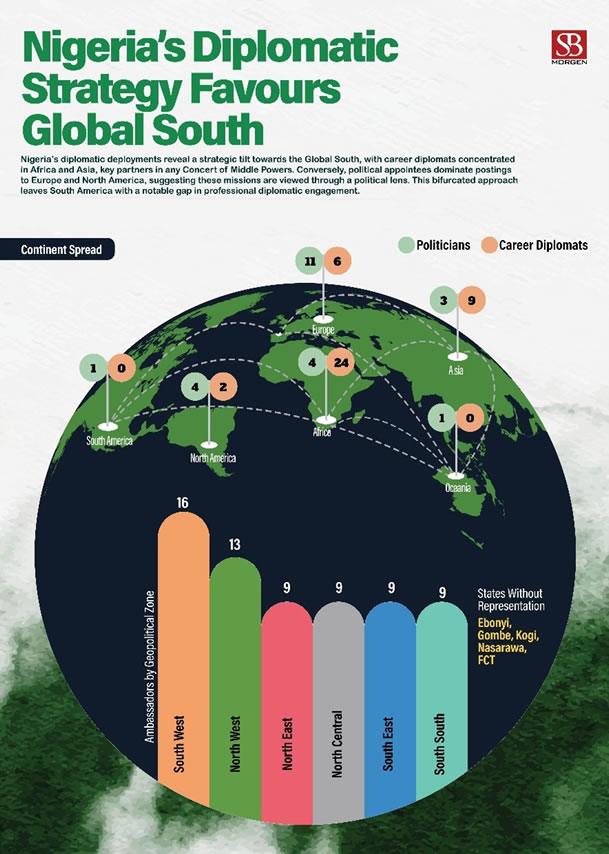
The data on our current ambassadorial postings is instructive. Of the 65 nominees, career diplomats dominate Africa (24) and Asia (9). Political appointees hold 11 of 17 European missions and 4 of 6 North American posts. South America receives one political appointee and zero career diplomats. Oceania, one political appointee.
On the surface, this looks like a strategic tilt towards the Global South, the kind of orientation thinkers like Bolaji Akinyemi envisioned when he proposed a "Concert of Medium Powers" in 1987. But the reality is less flattering. We have not made a strategic choice; we have simply run out of political debts to settle at home, so we send the professionals to “less juicy outposts” and send politicians to “juicy locations”.
The Business of Diplomacy
Embassies are not just reception halls for cocktail parties. Their core functions include market intelligence, trade advocacy, business support, and dispute resolution. Commercial officers identify opportunities for home-country companies. They negotiate market access, resolve trade barriers, and provide vital reporting on economic trends. They are the frontline of a country's economic warfare, opening doors that would otherwise remain closed.
An ambassador with a strong business background can be a powerful asset in this work. The case of Paolo Zampolli, an Italian-American businessman who helped broker a $20 billion Boeing aircraft deal with Uzbekistan in 20 minutes, illustrates how personal acumen and networks can accelerate commercial diplomacy. The nomination of David Perdue, a former CEO with deep experience in Asian supply chains, as US ambassador to China was an attempt to apply business pragmatism to a complex trade relationship.
Nigeria has appointed individuals with genuine business experience. Senator Jimoh Ibrahim, posted to the UN, built a conglomerate spanning banking (Nigeria, Ghana, São Tomé), insurance, hospitality, oil and gas, and infrastructure consulting in the UAE. Lieutenant General Abdulrahman Dambazau, heading to China, holds or has held board positions at FBN Holdings, UAC, Unilever Nigeria, Nigerian Breweries, and Flour Mills. Dr Okezie Ikpeazu, bound for Spain, founded a pharmacology business and promoted agricultural investment in Abia State. Olufemi Pedro, posted to Australia, is a co-founder of GTBank.
These are precisely the kind of appointees who could, in theory, use their networks and experience to open markets and attract investment. But their appointments appear accidental rather than strategic. They are scattered across missions with no apparent coordination. Pedro, a banking heavyweight, goes to Australia and the Oceanic states, a region with a combined GDP of over $1.75 trillion and massive demand for infrastructure, education, and financial services. It is a promising posting, but one wonders whether it resulted from a careful assessment of his skills or simply from the vagaries of political arithmetic.
The Patronage Problem
For the majority of political appointees, no documented business interests exist. Their qualifications are not commercial expertise but political loyalty. They are former governors, former lawmakers, and former party officials whose primary skill is navigating Nigeria's internal political terrain. They are sent to Washington, London, Paris, and Berlin, precisely the capitals where sophisticated economic diplomacy matters most, because they have served the ruling party, not because they understand the countries in which they will serve.
This is not merely inefficient; it is actively harmful. When a political appointee arrives in a major capital with nine months remaining before an election, unable to articulate Nigeria's economic priorities or leverage personal networks to advance trade, the message is clear: we do not take you seriously. The host country's business community notices. Investors notice. Competitor countries, which send their best professionals to these same capitals, notice.
The Missing Continent
The most glaring gap in Nigeria's diplomatic coverage is South America. With one political appointee and zero career diplomats, an entire continent of rising economic powers, including Brazil, Argentina, Chile, and Colombia, receives negligible professional attention. These are countries with which Nigeria shares structural similarities: large agricultural sectors, significant energy resources, and complex social challenges. They are natural partners in any medium-power coalition. They are also increasingly sources of investment and technology. Yet we treat them as an afterthought.
This is an oversight born of a system that prioritises domestic political calculations over foreign policy coherence. When ambassadors are chosen based on which politician needs to be rewarded, entire regions can fall through the cracks. The professionals who could build relationships in South America are sent to Africa and Asia, where, to be fair, they are also needed. The political appointees who could, in theory, be deployed there are instead sent to Europe and North America, because those postings carry greater prestige and therefore greater political value.
What the Business Community Must Do
The private sector cannot afford to remain passive while diplomacy is treated as a patronage dumping ground. Nigerian businesses lose contracts, miss opportunities, and face unnecessary barriers because our embassies lack the capacity to support them. When a company in Lagos wants to export to Brazil, there is no commercial attaché in São Paulo to help navigate regulations. When a manufacturer in Kano seeks investors from Germany, the ambassador in Berlin is more likely to be a former governor focused on his next political move than a professional diplomat focused on trade.
Nigeria's business community must become strategic about influencing ambassadorial selections. This means engaging with the presidency and the foreign ministry before appointments are made, rather than complaining afterwards. It means developing a clear set of criteria for what constitutes a qualified ambassador in key commercial posts and advocating for candidates who meet those criteria. It means building relationships with career diplomats who understand business realities, and ensuring they are deployed to missions where their skills can be most effective.
In countries that take economic diplomacy seriously, business associations are consulted on ambassadorial appointments. Chambers of commerce provide input on which candidates understand their sectors. Trade promotion agencies work closely with embassies to identify opportunities and resolve barriers. Nigeria does none of these. The result is a diplomatic service that serves politicians, not businesses; that rewards loyalty, not competence; and that treats foreign policy as a branch of domestic politics rather than a tool for national development.
The Way Forward
Bolaji Akinyemi understood that Nigeria's weight in the world would come not from aligning with great powers but from convening medium powers. That vision requires professional diplomacy across all continents. It requires ambassadors who can think strategically, not spokespersons who can deflect awkward questions. It requires a foreign policy that serves national interests, not political patronage.
The current arrangement – professionals (career diplomats) for the Global South, politicians for the West – reflects a colonial mindset we should have abandoned decades ago. It assumes that Europe and North America matter more, and therefore require political heavyweights, while Africa and Asia matter less, and can be handled by career staff. This is not only wrong; it is self-defeating. The countries that will shape the 21st century are precisely those in Asia, Africa, and Latin America, where we have chosen to deploy our professionals. By treating the West as a dumping ground for patronage, we signal that we do not take our relationships with the world's most powerful economies seriously.
Cheta Nwanze is the Founder of SBM Intelligence.
Latest Blogs By Cheta Nwanze
- Lagos flooding and the cost of weak urban resilience
- Nigeria’s job creation crisis story
- How kidnapping has become Nigeria’s economic war
- US-Israeli war with Iran opens doors to new world disorder
- How Nigeria's economic interests are underserved by its diplomacy



Subscribe
Subscribe now to receive newsletter from Financial Nigeria.