Access Bank is first Sustainability Certified African commercial bank
Feature Highlight
It is not in the least surprising that Access Bank would emerge as the first African commercial bank to become a sustainability-certified financial institution.
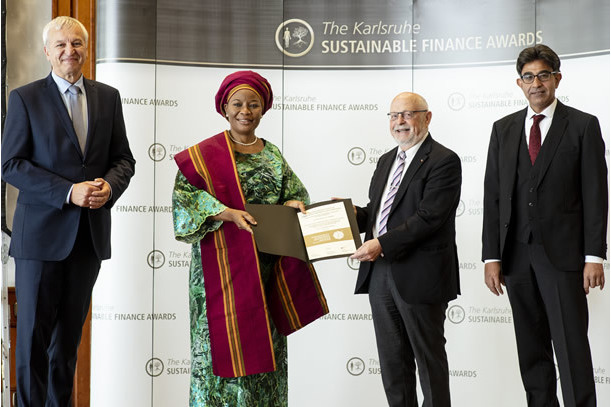
At a physically-distanced, in-person ceremony on September 30, 2020, Access Bank Plc was granted sustainability certification by the European Organisation for Sustainable Development (EOSD) under its Sustainability Standards and Certification Initiative (SSCI). The award ceremony, which held in Karlsruhe, Germany, was part of the programme of the 202o World Development Finance Forum (WDFF). Co-hosted by the EOSD and its partners, the WDFF was largely a virtual event. It drew over 300 virtual participants from over 35 countries across the world.
Given the subsisting international travel restrictions, Access Bank management and staff could not attend the in-person ceremony. But that was not a problem at all. Representing the Nigerian Ambassador to Germany, H. E. Mr. Yusuf Maitama Tuggar, Ambassador (Mrs.) Mobolaji Sakirat Ogundero, fdc, Deputy Head of Mission at the Nigeria Embassy Germany, was on hand to receive the certificate for the successful implementation of the Sustainability Standards on behalf of Access Bank. She also received on behalf of the bank its award plaque for winning the 2020 Karlsruhe Sustainable Finance Awards’ O u t s t a n d i n g B u s i n e s s Sustainability Achievement Award, and the certificate of admission of Development Bank of Nigeria into the SSCI programme.
The humility of Ambassador Ogundero was noteworthy and I would like to publicly appreciate her for her service to the country. As CEO of Financial Nigeria International, the Nigeria Country Partner to the EOSD, I had a minor role of coordinating the representation of the Nigerian institutions at the awards ceremony. Not only was Ambassador Ogundero approachable, she was helpful. I hope she also found the event useful for networking with other ambassadors who also represented the awardee financial institutions from their home countries at the ceremony.
According to Arshad Rab, Chairman of the International Council of Sustainability Standards, which administers SSCI, and CEO of EOSD, the certification programme was designed for those financial institutions that are driven by values, strongly committed to true and holistic sustainability and demonstrate the capacity of fulfilling the rigorous criteria of becoming sustainability certified.
Access Bank signed up to SSCI in July 2018. The bank was one of the carefully selected financial institutions to pioneer the implementation of the standards. Because they would be part of the co-creation of the Sustainability Standards, the institutions represented a broad spectrum of stakeholders in the financial services industry. Access Bank was selected in the commercial banking space. The other institutions include Uganda Development Bank, a state-owned development finance institution (DFI); Alliance Finance Corporation, a non-bank financial institution Sri Lanka; and ASKI, a microfinance bank in the Philippines.
These institutions and Reserve Bank of Zimbabwe – which provided the perspectives of a regulator – joined the EOSD and its partners on the international council. Over the next 18 months from July 2018, the council met regularly in Karlsruhe to review the draft Sustainability Standards, take the presentations of the applicant financial institutions on their implementation milestones and challenges, and provide useful feedback. The EOSD was also very useful in providing technical guidance to the banks between the in-person meetings before COVID-19 became a pandemic in Q1 2020.
There are core principles that underpin the Sustainability Standards. Banks implementing the standards have a crucial role of helping to transform their local and regional economies and make them inclusive, green, digital and sustainable. The banks are to pursue profit alongside social responsibility and environmental protection.
In a congratulatory message it sent to the Group Managing Director and CEO of Access Bank, Herbert Wigwe, after the award ceremony, the EOSD said Access Bank fulfilled the criteria of the world’s first holistic, robust and locally-sensitive set of standards to make value-driven financial institutions more resilient, profitable and key players in the implementation of national development agenda, the UN Sustainable Development Goals and protection of the natural environment in which they operate.
It is not in the least surprising that Access Bank would emerge as the first African commercial bank to become a sustainability-certified financial institution. During her presentation to the diverse audience attending the WDFF before the ceremony for the SSCI certification, Omobolanle Victor-Laniyan, Head of Sustainability at Access Bank, provided the highlights of the bank’s sustainability journey. These include the launch of the bank’s sustainability strategy 12 years ago, its steering role in creating the Nigerian Sustainable Banking Principles (NSBP), which is now a regulatory instrument of the Central Bank of Nigeria (CBN). Access Bank is also an early adopter or co-creator of many international initiatives for sustainable banking, including the Equator Principles, UN Global Compact, GRI reporting and UNEP-FI standards. The commitment and performance of Access Bank on sustainability has been validated in the most unquestionable way by winning the Most Sustainable Bank of the Year Award of the CBN, three years in a row from the inaugural edition in 2017 to last year.
SSCI is a practical tool for transforming banks, in terms of organizational purpose and setting measurable high impact goals, which then drive the institutional policy, governance, organizational culture and business models, among others.
I am also very familiar with the transformative impacts that the implementation of SSCI has had on Uganda Development Bank. The implementation of the standards has been instrumental to the renewed confidence in, and support of, the bank by its shareholder, the government of Uganda. Under the leadership of its CEO, Patricia Ojangole, UDB has been recapitalised and is a key partner of the government for the implementation of the second National Development Plan of Uganda. The international profile of the bank has also risen, setting the stage for broader resource mobilisation locally and internationally.
The successes of Access Bank and those of UDB highly recommend SSCI to Nigerian commercial banks and DFIs, as well as their African peers. Sustainable finance is the direction that global finance is being inexorably steered. SSCI provides very practical tools for banks to maintain institutional sustainability in the very dynamic banking industry that has continued to see new entrant financial technology (Fintech) firms eating the lunch of the incumbent, traditional banks. It is a matter of survival for the institutions, in terms of renewing their social licenses to operate, and our collective survival as people of the planet earth, that banks have to embrace holistic sustainability.
I heartily congratulate Access Bank on its great achievement as a Sustainability-Certified Financial Institution.
Jide Akintunde is Managing Editor and CEO of Financial Nigeria International Limited. He is also the Nigeria Country Representative of the European Organisation for Sustainable Development. He could be reached by email: jide@financialnigeria.com.
Other Features
-
Monica Cash gains ground as best crypto platform as Bitcoin to ...
Monica Cash gains ground as best crypto platform as Bitcoin to Naira transactions rise across Nigeria.
-
Where do jobs really come from: A short note
Jobs are not created for their own sake; they emerge when people perform tasks that create value others are willing ...
-
Driving Africa’s fair energy transition through technology and ...
Bart Nnaji canvases decentralised approaches as essential to Africa’s path towards universal energy access.
-
Africa is not poor. It is illiquid
Charles Awanda poignantly describes Africa as a continent trapped between abundance and paralysis, and where wealth ...
-
When infrastructure becomes a bottleneck: Why we need to invest in ...
To succeed, entrepreneurs must become ecosystem innovators, building not only their products or services, but also ...
-
How Much Is a $100 Apple Gift Card in Naira: Best Rates
Find out how much a $100 Apple gift card is worth in Naira and where Nigerians are getting the best rates today.
-
Bridging the CPI gap: What Nigerian investors actually earned ...
Whether the NBS eventually publishes its own chain-linked series or the market continues to rely on independent ...
-
-
Repositioning BDCs through controlled participation in Nigeria’s ...
The new CBN directive embeds demand within a controlled structure that aims to increase transparency, improve price ...


Most Popular News
- Nigeria emerges as the world’s most generous country
- China VC funding value more than triples, finds GlobalData
- Dangote Sugar launches $353 million rights issue to fund expansion
- Artificial intelligence can help to reduce youth unemployment in Africa – ...
- UN presses Nigerian government on human rights violations in Middle Belt
- World Bank debars Chinese state-owned company
Quick Search for Upcoming Events
Event Categories