John and Leni Chigbu

Summary
The Power Couple Transforming Africa’s Healthcare
In this special feature interview, John and Leni Chigbu, Chief Executive Officer and Chief Operating Officer of Cassona Global Imaging Limited, reflect on the inspiration, purpose and partnership behind their mission to transform healthcare delivery across Africa. In a conversation with Jide Akintunde, Managing Editor of Financial Nigeria publications, they speak candidly about their professional journey, their shared love for Africa’s cultures, and the values that anchor their work and marriage.
From their pilot investment in Accra, Ghana, in 2022, Cassona Global Imaging has reshaped the country’s diagnostic landscape with the deployment of more than 385 imaging systems in under three years, followed by the establishment of a world‑class medical facility. After proving its model in Ghana, the company expanded into Nigeria, bringing its integrated approach to diagnostic excellence, healthcare infrastructure, and ecosystem development.
Founded originally in the United States – where the Nigerian‑Chinese couple met and built their careers – Cassona now delivers unmatched solutions for strengthening Africa’s healthcare value chain. Theirs is a story of professionalism, empathy, commitment, and above all, love: love for each other, love for their work, and love for the continent they are helping to heal.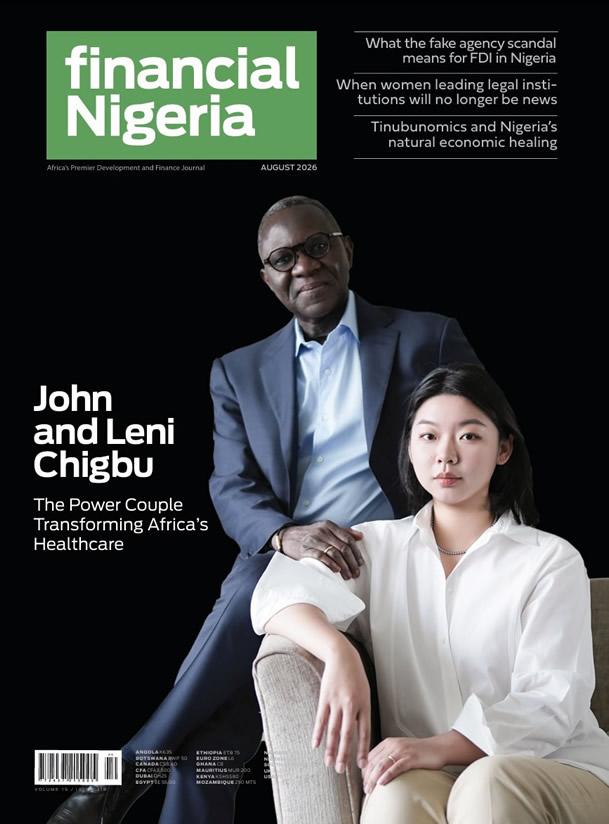
John and Leni Chigbu on the front cover of Financial Nigeria magazine, August 2026 issue
Jide Akintunde (JA): Knowing that Cassona Global Imaging is rooted in family, it’s wonderful to feature you both as a power couple. Could you briefly share how your journey together first began?
John and Leni Chigbu (JLC): John and I first met as law colleagues in the United States eight years ago. Since we shared the same legal speciality – corporate tax law – and had great respect for each other’s professional work, our relationship naturally grew from mutual admiration into love and eventually marriage.
We appreciate the term “power couple.” It is certainly a glamorous and generous description, but at heart, we are like any other couple who have built a life together over the years. What has brought us closer is not only our shared professional background, but also our alignment in values, interests, and purpose. One of the areas where we have found the greatest connection is our shared commitment to improving access to healthcare in underserved and disadvantaged communities around the world.
JA: What was the spark or turning point that made you both decide to channel your energy into transforming Africa's healthcare landscape?
JLC: The spark behind our mission was the loss of my mother in Nigeria. She was diagnosed with breast cancer, but due to the lack of access to timely diagnostic imaging and healthcare resources, her condition was discovered at a stage when it was too late for treatment to save her life.
I remember telling my wife that I wanted to bring her to meet my mother. However, the COVID-19 pandemic began in 2020, and the resulting global lockdowns made travel impossible. Sadly, my mother passed away in November of that year, and that meeting never took place. The pain of knowing that the two most important women in my life never had the opportunity to meet became a deeply personal motivation for us to return home and dedicate ourselves to improving healthcare access.
Together, we made the decision to contribute our efforts toward building the healthcare infrastructure that Sub-Saharan Africa urgently needs, with the hope that no other family would have to experience a similar loss due to a lack of basic medical resources.
Although Cassona was originally founded in the United States as a renewable energy project company, we made a strategic pivot into healthcare in 2020. Following extensive research, including support and guidance from the U.S. Commercial Service, we selected Ghana, specifically Accra, as the location to validate our vision. In 2023, we relocated there to demonstrate that with access to appropriate healthcare technologies and diagnostic tools, many deaths caused by preventable and treatable illnesses can be avoided.
JA: The gap in Africa’s healthcare and the continent's geographic scale are immense. How did you take those critical first steps to translate your resolve to start Cassona into its first operational milestones?
JLC: Our collective experience managing the financial affairs of multinational corporations has been invaluable in preparing us for this undertaking. We approached the healthcare challenge through a framework we call the “Triple A Cassona Principle” – Acute, Accessible, and Affordable Healthcare.
Acute represents our commitment to delivering timely and accurate diagnostic results. Early and precise diagnosis is the foundation of effective treatment and is critical to improving patient outcomes.
Accessible represents our mission to make Cassona Healthcare services and solutions available to both healthcare providers and patients, geographically and financially. We aim to establish strategically located healthcare centres while partnering with financial institutions, both locally and internationally, to develop extended payment plans and credit facilities. These financial solutions enable healthcare providers to acquire essential medical equipment and allow patients to access necessary treatments without the burden of immediate, unaffordable costs.
Affordable applies equally to providers and patients. Healthcare providers should be able to acquire high-quality medical equipment without paying excessive premiums based solely on brand recognition. By offering competitively priced healthcare technologies together with flexible financing options, we can increase the number of deployed medical devices and expand diagnostic capacity. For patients, affordability means greater access to treatment options at sustainable costs.
Our model is built on the belief that increased access creates a virtuous cycle: when more providers have access to affordable healthcare tools and more patients can access financing options for treatment, healthcare utilisation increases, operational efficiency improves, and the overall cost of care decreases through economies of scale.
A comparable example is Coca-Cola, where the price of a product varies across markets based on scale and consumer volume. Larger markets benefit from lower unit costs because fixed costs are distributed across a broader customer base. We believe the same principle can be applied to healthcare. By expanding the network of healthcare providers and patients utilising private healthcare services across West Africa – a region with an estimated population of approximately 477 million people – we can create a larger, more efficient healthcare ecosystem.
For example, if approximately 25% of the population (around 120 million people) were able to access private healthcare services and contribute an average of $10 toward healthcare consumption, the potential market opportunity would exceed $1.2 billion annually. As participation grows, increased volume and efficiency should contribute to significantly reduced costs for both providers and patients.
This scalability principle has been demonstrated by successful global business models such as Coca-Cola, Alibaba, and McDonald’s, where expanding consumer access in large and growing markets has enabled lower costs, broader adoption, and sustainable growth.
Cassona’s vision is to apply these proven principles of scale, accessibility, and affordability to healthcare – creating an ecosystem where providers can thrive, patients can receive timely care, and communities benefit from improved health outcomes.
JA: Since starting operations in Accra in 2022, you’ve scaled across borders and even picked up a prestigious diagnostic excellence award. Looking back over these past four years, what achievement are you most proud of as a team?
JLC: One of our greatest achievements is proving that West Africans can be trusted partners in credit-based financing when qualified through responsible evaluation and structured financial models. We are equally proud of the progress we have made in expanding healthcare access, having successfully deployed more than 385 diagnostic imaging systems across Ghana within three years – all within the private healthcare sector.
I recall a defining experience in 2024 when we travelled to China to seek funding and partnerships for healthcare equipment expansion in West Africa. During our discussions, we encountered significant scepticism regarding the viability of the African healthcare market. I remember sharing the tremendous opportunities within Nigeria’s healthcare sector with Mr Wu Hao, a Senior Director at MEHECO, a Chinese medical export company. After hearing our market analysis, he interrupted the discussion several times to state that “there is no money in Nigeria” and that their preference was to extend credit to countries such as Algeria.
The experience was disappointing, not because of one individual’s perspective, but because it reflected the persistent misconceptions and stereotypes that continue to limit investment and opportunity in African markets. My wife and I discussed how striking it was to hear such assumptions from a country that, only a few decades ago, faced similar perceptions and scepticism from the international community. China’s remarkable transformation serves as a powerful reminder that economic progress is possible when societies are given the opportunity, resources, and confidence to develop.
Unfortunately, many African nations continue to face similar challenges, often driven by outdated assumptions rather than current realities. This reinforces our belief that Africans must play a leading role in shaping and accelerating the continent’s development. Through Cassona, we are committed to demonstrating – through measurable results – that African businesses, healthcare providers, and consumers can be trusted partners in building sustainable, scalable solutions.
Our progress in Ghana is evidence that with the right infrastructure, financing mechanisms, and partnerships, African markets can support successful business models while delivering meaningful social impact.
JA: Family is the bedrock of Cassona. How challenging has it been to balance leading such a rapidly growing business with nurturing and growing your personal relationship?
JLC: Our personal relationship has grown even stronger over the years as we have faced and overcome the many challenges that come with building a new venture in an unfamiliar environment. The experience of navigating uncertainty, adapting to new circumstances, and overcoming obstacles together has deepened our partnership and strengthened our bond.
We take great pride in the challenges we have overcome and make a conscious effort to appreciate life beyond our work. We enjoy travelling together and finding time to reconnect in meaningful places, such as Morocco, where we can step away from our responsibilities and share quiet, personal moments.
We are both deeply private individuals and value the rare opportunities we have to be together away from the demands of our mission and daily commitments. As the saying goes, “tough times do not last, but tough people do.” My wife embodies that strength. She has taken on responsibilities and challenges that would overwhelm many, yet she has done so with resilience, grace, and determination. That strength and character are among the many reasons I knew she was the person I wanted to share my life with.
JA: Given your cross-jurisdictional success in Africa, combined with the years you both spent honing your careers in the United States, what critical advice would you give African health policymakers to accelerate the transformation of the sector?
JLC: Healthcare policymakers and government leaders must first recognise that a sustainable healthcare system is one of the most critical forms of infrastructure a nation can develop. Healthcare is not merely a social service; it is an economic foundation that preserves a country’s most valuable asset – its human capital.
A strong healthcare system reduces preventable mortality, improves workforce productivity, mitigates the loss of physicians and nurses through brain drain, and reduces capital flight caused by citizens seeking medical treatment abroad. Furthermore, countries with reliable healthcare infrastructure are better positioned to attract foreign direct investment, as investors are more likely to commit resources to markets where the health and well-being of their workforce and communities can be sustainably supported.
Given these significant and widely recognised benefits, policymakers should consider meaningful economic incentives to accelerate healthcare development. These may include duty-free importation of essential healthcare equipment, fiscal incentives for healthcare investors, streamlined regulatory processes, and policies that encourage financial institutions to provide credit facilities to qualified healthcare providers.
Such measures would strengthen private-sector healthcare capacity, complement public healthcare systems, and allow governments to allocate limited resources toward other critical sectors, including agriculture, education, transportation infrastructure, energy, and digital connectivity.
I strongly believe in the power of public-private partnerships (PPP) as a pathway to sustainable healthcare transformation. Experience has shown that government-operated healthcare facilities often face operational challenges due to limited resources, bureaucratic constraints, and the absence of market-driven accountability. Strategic partnerships with private-sector investors – both domestic and international – can introduce capital, innovation, efficiency, and operational expertise into the healthcare ecosystem.
By creating an environment where government provides the appropriate policy framework and the private sector contributes investment, technology, and management expertise, healthcare can evolve from a persistent national challenge into a dynamic and productive sector of the economy – one that improves lives while contributing meaningfully to economic growth and GDP expansion.
JA: In a highly competitive medical and diagnostic equipment market, what truly defines the Cassona edge?
JLC: Our most recent recognition, awarded through an official industry poll conducted by the Ghana Medical & Diagnostic Excellence Award Committee, best reflects the qualities that define Cassona’s competitive advantage. The evaluation highlighted five key areas:
- Quality and reliability of imaging equipment
- Technical support and local maintenance capabilities
- Industry reputation and professionalism
- Contribution to the advancement of diagnostic healthcare
- Customer satisfaction and operational efficiency
Cassona achieved a score of 48%, surpassing the collective score of established global healthcare equipment distributors (GPS), which scored 46%. We believe these results demonstrate that our strength extends beyond simply providing medical equipment. Our advantage lies in delivering a complete healthcare ecosystem built on reliability, service, trust, and long-term partnership.
Beyond equipment deployment, we remain committed to continuously training local healthcare providers on advanced diagnostic technologies, promoting innovation, and expanding our solutions to benefit a broader segment of the population. We believe sustainable healthcare transformation requires not only access to tools but also the knowledge, technical capability, and support systems necessary to use those tools effectively.
Cassona has also developed financing solutions to expand healthcare access by providing credit facilities to qualified private healthcare providers. We have extended this approach to patients utilising our own diagnostic centres, helping to reduce financial barriers to timely medical care.
In addition, we have expanded our vision beyond diagnostics by developing healthcare facilities that are operated by our own trained personnel. To strengthen the professional healthcare workforce in the region, we are actively engaging members of the African diaspora from countries including China, the United Kingdom, and the United States, creating meaningful opportunities for skilled professionals to return home and contribute to the continent’s healthcare development.
Our goal is to build not only a healthcare company, but a sustainable healthcare ecosystem—one that combines technology, financing, expertise, and human capital to improve access and outcomes across Africa.
JA: As a multinational power couple, what are your favourite ways to unwind and experience the culture in the countries where you operate? And with such a demanding schedule, how do you intentionally carve out time to disconnect from work entirely?
JLC: Africa is a remarkably diverse and multicultural continent, and we believe more people should have the opportunity to experience all that it has to offer. Beyond our professional mission, we have developed a deep appreciation for the continent’s rich cultures, traditions, landscapes, and cuisines.
Whenever our schedule allows, we enjoy exploring different countries, experiencing local customs, sampling regional cuisine, and visiting nature reserves where we can observe wildlife in its natural environment. These experiences have given us a deeper appreciation for the beauty, diversity, and spirit of Africa.
My wife, in particular, has developed a special affection for Lagos – especially for the opportunity to enjoy one of her favourite local delicacies, “isi ewu.” It still brings us great amusement that a Chinese woman has developed such a strong appreciation for this traditional Nigerian dish!
Because our eight-year-old daughter attends school in Accra, our home has naturally become a gathering place for her friends and classmates. We often find ourselves surrounded by a lively group of children, and in many ways, we have built a much larger “family” than we ever expected. We both genuinely enjoy the energy, curiosity, and innocence that children bring into our lives.
In 2024, we acquired a home in Marrakech, Morocco – another city rich in history, culture, and beauty – where we occasionally retreat to reconnect, recharge, and enjoy quiet time together away from our demanding responsibilities.
My wife has recently expressed interest in having a home in Lagos as well. I suspect her love for “isi ewu” may have played a significant role in that decision!

Recent Interviews


Latest Blogs
- Nigeria’s democratic illogic
- The scourge of public infrastructure vandalism
- Can Nigeria’s new deep offshore incentives unlock capital?
- Was Nigeria absent or excluded from WAICO?
- Governor Peter Mbah’s Tomorrow Enugu
Latest News
- BoE rate hold draws criticism as inflation climbs above 3 per cent
- World Bank mobilises $112bn in private capital for developing countries
- ECA, DHL join forces to boost African SMEs' cross-border trade
- Nigeria returns to J.P. Morgan bond index after more than a decade
- GSMA warns soaring smartphone costs could create a global AI divide

Subscribe
Subscribe now to receive newsletter from Financial Nigeria.