
Latest News
IFC launches $2bn green bond as investor demand surges to record levels

News Highlight
The bond, IFC’s first US dollar green benchmark since 2017 and the first issued under its updated 2026 Green Bond Framework, attracted an $8 billion orderbook supported by 120 investor orders.
The International Finance Corporation (IFC) has kicked off its new fiscal year with a major return to the US dollar green bond market, issuing a $2 billion 5 year green benchmark bond that drew strong global investor demand.
The bond, IFC’s first US dollar green benchmark since 2017 and the first issued under its updated 2026 Green Bond Framework, attracted an $8 billion orderbook supported by 120 investor orders, underscoring the appetite for high quality sustainable assets from a triple A-rated supranational organisation.
The bond pays a 4.25% semi annual coupon and is priced at a 1.7 basis point spread over the reference US Treasury. It will be listed on the Luxembourg Stock Exchange.
Investor participation was geographically diverse: EMEA investors (41%), Americas (31%), and Asia (28%).
Central banks and official institutions accounted for 61% of investors; banks and corporates represented 21%; and asset managers, insurers, and pension funds accounted for 18%.
Joint lead managers were BMO Capital Markets, Citigroup Global Markets Limited, Goldman Sachs International, and J.P. Morgan.
Jorge Familiar, Vice President and Treasurer of the World Bank Group, said the strong market reaction reflects the global shift toward sustainable finance.
IFC said its updated Green Bond Framework, validated by S&P Global Ratings, fully aligns with the International Capital Market Association's Green Bond Principles.
Proceeds from the bond will support projects across key environmental priorities, including climate change mitigation, adaptation and resilience, biodiversity and nature protection, ocean and water conservation, and circular economy initiatives.
The framework also emphasises development outcomes such as quality jobs, resilient livelihoods, and inclusive economic participation, reflecting IFC’s focus on climate smart private sector growth.
IFC has issued US dollar-denominated global bonds every year since 2000. In addition, it complements its public issuance by accessing a range of markets, including private placements and thematic bonds, such as green bonds to support climate-smart business and social bonds that fund IFC projects to help underserved people in developing countries with limited access to essential services. IFC also issues local-currency bonds to develop local capital markets and to fund local-currency investments.
The institution, which is part of the World Bank Group, is the largest global development body focused on the private sector in emerging markets, with a fiscal year running from July 1 to June 30.
Related News
-
World Bank mobilises Euro 2.5 billion for sustainable development
The transaction attracted over 75 orders totalling almost EUR 4 billion, from European and global investors seeking safe and ...
-
Stanbic IBTC to become a sustainability-certified financial institution
Stanbic IBTC embarks on a holistic sustainability journey, begins implementation of global sustainability standards for ... -
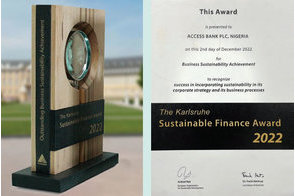
Access Bank wins Outstanding Business Sustainability Achievement award
EOSD says its awards provide recognition to financial institutions that have successfully embedded economic, social and ...


Latest Blogs
- Startups are becoming Nigeria’s new social infrastructure
- Politics as the engine of economic transformation
- What the fake agency scandal means for FDI in Nigeria
- Lagos flooding and the cost of weak urban resilience
- The hidden cost of convenience in our changing diets
Most Popular News
- MTN engages global bond investors as IHS Towers acquisition nears
- Export development fund expands to Senegal and Liberia
- Uber leaves Nigeria and Uganda as part of wider global restructuring
- South Korea, Africa to focus on AI and digital infrastructure at conference
- Oil prices stay elevated as Middle East tensions raise supply concerns
- Ghana offers sweeter terms to attract new oil investment
Quick Search for Upcoming Events