Vulnerability of women leaders to anticorruption
Feature Highlight
While corruption may be gender-neutral, anticorruption has been gender-biased against women.
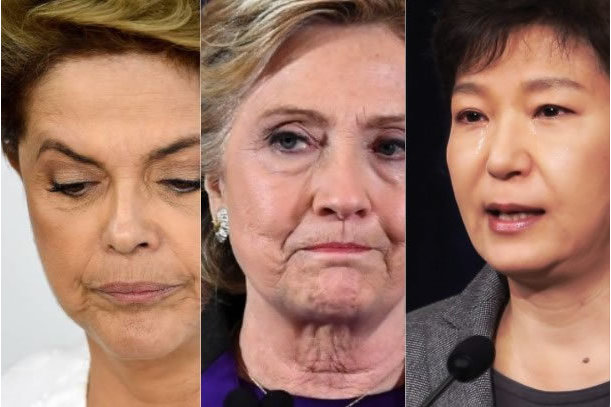
Last August, the 36th president of Brazil, Dilma Rousseff, was removed from office following her impeachment on the allegation that she falsified the budget deficit to aid her re-election in 2014. Later, in November, Hillary Clinton, the first female candidate of a major US party, suffered improbable loss in the presidential election. Her alleged untrustworthiness stuck, and it swayed victory in favour of Donald Trump who is serving as the 45th President of the United States.
And, this March, South Korea's Constitutional Court upheld the impeachment of President Park Geun-hye. She was the 11th president of the country. Several accusations of her wrongdoings culminated in her removal from office, on the allegation that her adviser had used her unofficial position to solicit bribes from some of the country's large conglomerates.
For the avoidance of doubt, these women leaders have been the biggest casualties of public and institutional repudiation of corruption, across the advanced and emerging markets, in recent times. That all three are women appears to counter the notion that women are better disposed than men in promoting honest government.
Clinton was stopped in her tracks from becoming the first female president of the United States. But the accusations against her date back to when she was Secretary of State. They include her use of a private email server as Secretary of State and lying about it; using her influence in government to attract donations to the Clinton Foundation; and granting expensive speeches to Wall Street businesses. The consequences suffered by Clinton and these other women leaders for their alleged corruption have stood out. They now raise the question: are women leaders more corrupt than their male counterparts?
It is counter-intuitive that women would be more corrupt in government than men. Women don't have the numbers to be so dominant. The global affirmative action benchmarks 35 percent women representation in the elective and appointive positions. Many countries have yet to attain this mark.
However, the hypothesis that women constitute the fairer sex – the idea that women are more honest in government – has been hardly affirmed. Justin Esarey and Gina Chirillo found that sex gap in corruption exists, but only in the institutional and cultural context of the democratic countries. In the democracies, women would be more restrained in tolerating or participating in corruption in government than men. But women and men share same attitudes towards corruption in the world's autocracies.
Gender disparities in corruption may not be that smartly theorised anymore. We may quibble over the extent of the democratic cultures of Brazil and South Korea. But if the United States is not a democracy, then no country is. Clinton's alleged grafts, therefore, impugns the framing of corruption in ways that feed the stereotype of autocratic developing countries. With similar sophism, developing countries who are the biggest victims of global corruption, rank mostly lowest on Transparency International's corruption barometer.
While corruption may be gender-neutral, anticorruption has been gender-biased against women. Clinton ran against Donald Trump, who created a moral exceptionalism for himself. Promoting self-conceited invincibility and impunity, he declared ahead of the 2016 election that “I could stand in the middle of 5th Avenue and shoot somebody and I wouldn't lose voters.” Later during the campaign, a video in which he boasted about groping women without their consent swirled in the media. Yet Mr. Trump continued to make the election a moral decision for the U.S. electorate by his “Crooked Hillary” chants. He was not held accountable, at least for adding boastfulness to his own dishonourable behaviours. Clinton lost the election.
The impeachment of Presidents Rousseff and Park demonstrated zero tolerance for corruption involving a female president in Brazil and South Korea. Both women were the first female presidents in their different countries. But some of the corruption allegations President Rousseff was embroiled in dated back to when her political godfather, Ignacio Lula da Silva, was the 35th President. The allegations of malfeasance that brought down President Park have been long associated with the country's political economy that created the chaebol conglomerates, including Hyundai, Samsung and LG. However, in both Brazil and South Korea, none of the total 45 past male presidents was successfully removed from office through impeachment. (Brazilian President Fernando Collor de Mello resigned before he could be removed from office through impeachment, while the impeachment of South Korea's Ro Moo-Hyun was overturned by the court and he was restored to power.)
The successful ousting of the two women leaders, with Clinton's loss of the election, shows more vulnerability of women to anticorruption, compared to men. When President Umaru Yar'Adua came to office in Nigeria in May 2007, he promised to fight corruption. His predecessor, President Olusegun Obasanjo, had created the Economic and Financial Crimes Commission (EFCC) and used the agency more notably to cripple his political opponents. But in less than eight months, the biggest three fish caught in the anticorruption dragnet of President Yar'Adua were women functionaries in government.
Mrs. Patricia Etteh, the first female Speaker of the House of Representatives, had to resign her position just ahead of being impeached. She was indicted for a N628 million contract scam involving the renovation of her official residence and that of her deputy, and the purchase of 12 official cars meant for the House. Etteh's successor, Dimeji Bankole, served out his term, although he was embroiled in a N40 billion scam for much of his tenure as Speaker.
The two other women were Senator Iyabo Obasanjo, Chair of Senate Committee for Health; and Minister for Health, Prof. Adenike Grange (her deputy, a man, was also involved). They were investigated by the EFCC for embezzlement of public funds. N300 million in unspent budget was shared by the officials and a couple of top civil servants in the Ministry, instead of returning the fund to the public coffer. Prof. Grange and her deputy had to refund the money and resign.
Women confront four abiding challenges when they make it to top government positions. One, they constitute a tiny minority. This doesn't elicit support but antipathy from the male establishment. Women have to deal with cynicism and prejudice in their push for, or attainment of, top positions in both the public and private sectors. Donald Trump mocked the idea of Carly Fiorina's woman face for a U.S. President, and called Hillary Clinton's bathroom break during a December 2015 presidential debate of the Democrats “disgusting.”
Two, the few women, coming newly into top government positions, often lack experience of political power dynamics. Prof. Grange, an academic and a Paediatrician of international recognition, was misled by the norm whereby unspent budgets were “shared” at the end of each fiscal year. The Fiscal Responsibility Commission, which oversees the remittance of unspent budget, has continued to remonstrate over low compliance by government agencies. But since scapegoating Senator Obasanjo and Prof. Grange, no high-profile case of noncompliance has been dealt with such decisiveness in Nigeria that continues to experience about 60 percent average rate of implementation of the capital expenditure.
Three, women lack consequential solidarity. Such solidarity can be useful in sharing experience and pushing back against male chauvinism. But the invincibility of male leaders is, in part, promoted by their fraternity.
Four, societal norms hold women to higher moral standards than men. Virginity at marriage is a virtue for women, which men need not even aspire to. But this is not because women are seen to be superior to men; it is integral to the sexism against women. Nevertheless, the positive stereotype of women's higher morality often make them suffer backlashes. When a woman trips the moral hurdle, it is considered graver than when men do.
However, the argument for a progressive improvement in honest government may serve a rationale for the lack of forbearance on corruption by women. After all, it is believed that gender-inclusivity is necessary in improving the prospects of good governance. Therefore, it would be more frustrating if women in government perpetrate the same malaise that men have made business as usual.
But selective anticorruption cannot pass muster. The recent public reactions to corruption in the United States, Brazil and South Korea may suggest that women's involvement is not acceptable in ways that men's involvement is. Since women may be naturally as corrupt as men, holding women to higher moral standard will only slow gender-inclusivity in government. It will also continue to be a negative incentive for wrongdoings by male leaders.
A case for tolerance of corruption by women leaders is also morally bankrupt. But the higher vulnerability of women to anticorruption cannot promote honest government. We have to denounce prejudicial anticorruption.
Jide Akintunde is Managing Editor, Financial Nigeria publications. He is also Director, Nigeria Development and Finance Forum.
Other Features
-
-
Analysis of Nigeria’s new virtual asset taxation framework
The framework is technically rigorous and sound, but its success will depend heavily on administrative capacity and ...
-
No free ride: Uber’s African retreat
Nigeria hardly offered Uber a competition-free road. Uber was not even the country’s first ride-hailing ...
-
What will determine the next gold price movements
Gold still has strong bullish fundamentals over the medium term. However, the path toward higher levels is unlikely ...
-
What would make Sidi Ould Tah smile?
After a year in office, Sidi Ould Tah has begun to reshape how the African Development Bank raises money and prepares ...
-
Nigeria’s Paris Club debt deal: A factual rejoinder to Donald Duke
Obasanjo’s credit was never in danger and did not require Duke to vandalise everyone else’s contribution.
-
Where to sell Steam gift cards in Nigeria: Rates, apps and how to ...
See where to sell Steam gift cards in Nigeria, current 2026 Steam card rates, and how to get paid on ...
-
Nigeria is building a sustainable health financing future
Gavi’s US$500 million support will help protect Nigeria’s children over the next five years while ...
-
An analysis of the Executive Order on Virtual Assets 2026
The new presidential executive order addresses a real problem – the cost and risk of regulators working in ...


Most Popular News
- Dangote Refinery posts $1.82 billion profit ahead of landmark IPO
- BoE rate hold draws criticism as inflation climbs above 3 per cent
- Alliance to End Plastic Waste reports progress on circular economy
- AfDB approves $5.1 billion response to energy and fertiliser shocks
- Digital services boom widens global trade gap, UNCTAD says
- GSMA warns soaring smartphone costs could create a global AI divide
Quick Search for Upcoming Events