Trump’s corporate lackeys
Feature Highlight
Business leaders everywhere should use their influence to stand up to authoritarian governments wherever they are in the world.
In mid-August, alt-right, neo-Nazi, and white supremacist groups, including the Ku Klux Klan, gathered in Charlottesville, Virginia, for a demonstration that ended with a white supremacist driving a car into a crowd of counter-protesters, killing one and injuring 19. President Donald Trump responded not by condemning the racist terror, but rather by blaming “many sides” for the violence. For many members of his manufacturing council and the Strategy and Policy Forum, it was the last straw. But the camel’s back actually broke a long time ago.
The first few council members who resigned were labelled “grandstanders” by Trump. But then a trickle of resignations became a wave, and Trump, apparently fearful of a full-scale revolt by the business leaders who were supposed to advise him, quickly dissolved the two economic councils, tweeting that he didn’t want to put pressure on their members.
Perhaps he need not have worried. Yes, some members of Trump’s business advisory bodies took a stand. But it was too little, too late. After all, as appalling as Trump’s response to the events in Charlottesville was, no one could credibly claim to have been shocked by it. On the contrary, from day one, there were clear signs that this administration was toxic. Even the councils themselves were little more than a tool for boosting Trump’s ego, by stoking his self-image as a businessman’s businessman.
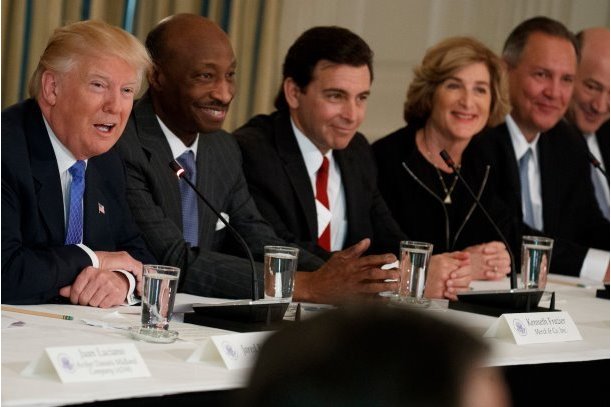
Yet, while a few council members resigned after Trump withdrew the United States from the Paris climate agreement, the majority remained, owing to an overriding desire for prestige and access. They participated in photo opportunities wearing painted-on smiles, nodding and shaking one another’s hands. They surely relished sharing anecdotes with their investors and boards that began with, “When I was at the White House last week …”
Blatant ethics violations? Check. Repeated lies regarding ties with Russia? Check. Tweeted threats of nuclear war? Check. Only when Trump implicitly validated literal Nazism did they feel compelled to weigh their options.
These business leaders cannot credibly claim that they believed, until last week, that they could be a moderating influence on Trump. If that were the case, there would have been some indication of it over the last seven months. But there was none. On the contrary, Trump repeatedly went off script, revealing beliefs and feelings that showed him in the worst possible light.
In fact, by choosing to remain on Trump’s councils for so long, these business leaders implicitly endorsed his authority, which, as he showed time and again, he was unfit to wield. For members of Trump’s economic councils, no less than for members of his administration, standing beside the president amounted to standing with him. In effect, these leaders validated Trump’s outrageous positions on a broad range of issues, from his plan to build a wall with Mexico to his repeated attempts to bar citizens of several Muslim-majority countries from entering the US.
No one should underestimate the impact of this stance. Trump’s economic councils comprised the heads of some of the world’s largest companies. Their actions matter. Their decision to associate themselves with an administration launching repeated assaults on democratic principles is highly significant – and not just for the US. In fact, the firms that were represented – such as Walmart, PepsiCo, JPMorgan Chase, and General Motors – together affect the lives of most people on the planet.
Within their firms, these leaders espouse the importance of diversity and action to combat climate change. They claim to value their role as global stakeholders. They tout their standing in America’s “best employers” rankings. But, by choosing to remain silent about Trump’s behavior and policies, such assertions became worthless.
In a global context, continued collaboration with Trump’s White House should be viewed as akin to doing business with – and thereby propping up – corrupt governments. With the exception of the Soviet bloc, no modern dictatorship has been established and sustained without the supporting role of business, be it diamond and coltan mining in conflict zones in Africa or oil companies in the Niger Delta. Companies like Bayer and BASF (then part of chemical giant IG Farben), Siemens, and the Volkswagen Group are still remembered for having profited from their close collaboration with the Nazis.
CEOs worldwide must recognize not just their influence and authority – of which most are probably quite proud – but also their responsibility to advance humane values and goals. They must stand for something greater than their own self-interest or the returns they are delivering to investors. If the moral imperative of standing up to oppression is not enough to drive a company to act, perhaps the need to protect the company’s reputation will be.
One might argue that, now that Trump’s economic councils have been disbanded, the issue is moot. But companies’ responsibility extends beyond participation in those councils. Now is not a time for politicking or parsing words. Business leaders must stand up and show genuine leadership, integrity, and respect for ethics. They must make clear that they do not stand with Trump, as he drives his country toward destruction.
This does not apply just to Trump or the US. Business leaders everywhere should use their influence to stand up to authoritarian governments wherever they are in the world. They and their companies have never been more powerful. They should be using their might to fight for a better future, not for a seat at the tyrant’s table.
Lucy P. Marcus, founder and CEO of Marcus Venture Consulting, Ltd., is Professor of Leadership and Governance at IE Business School and a non-executive board director of Atlantia SpA. Copyright: Project Syndicate
Other Features
-
TCN's multifront response to transmission line vandalism
As vandalism continues to threaten Nigeria's electricity infrastructure, TCN is strengthening its response through ...
-
The national digital cloud policy and data processing in Nigeria
The implications of the new policy for businesses and organisations extend beyond the location of their data.
-
What the eye can tell us about a Nigerian’s health
Diabetes and high blood pressure can leave signs in the eye, sometimes before a person notices a change in sight.
-
Beyond the Dangote IPO: What happens when the promise is tested
Every investor weighing the Dangote offer is making a judgement about the future, knowing there are no guarantees.
-
-
Analysis of Nigeria’s new virtual asset taxation framework
The framework is technically rigorous and sound, but its success will depend heavily on administrative capacity and ...
-
No free ride: Uber’s African retreat
Nigeria hardly offered Uber a competition-free road. Uber was not even the country’s first ride-hailing ...
-
What will determine the next gold price movements
Gold still has strong bullish fundamentals over the medium term. However, the path toward higher levels is unlikely ...
-
What would make Sidi Ould Tah smile?
After a year in office, Sidi Ould Tah has begun to reshape how the African Development Bank raises money and prepares ...


Most Popular News
- Foreign investors continue to favour Nigerian debt over stocks
- CPSG to host symposium on professionalising public enterprise board appointments
- Nigeria confirms Ebola case in Abuja, launches contact tracing effort
- World Bank backs petrochemical growth over decarbonisation
- Process Vision launches initiative to recognise workplace ‘unsung heroes’
- Africa launches continental credit rating agency
Quick Search for Upcoming Events
Event Categories